







CINELATION | Movie Reviews by Christopher Beaubien
Subscribe
Siren
HAL 9000

Platinum

Movie Review: THE FALL (2008)

by Christopher Beaubien • September 12, 2008 • Start the Discussion!

2008:

2024: Reels_5.0

the_fall_top

Alexandria In Wonderland

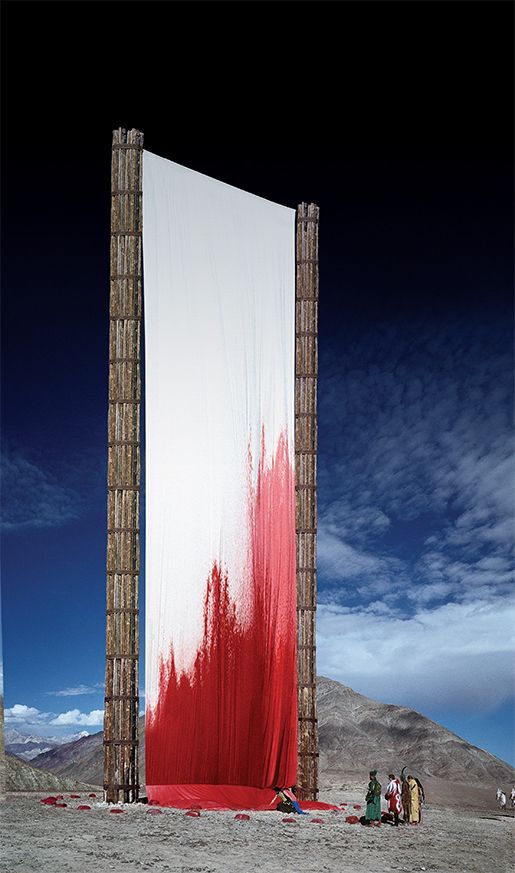
Once upon a time, six-year-old Alexandria (Catinca Untaru), one of the injured patients in a Los Angeles hospital circa 1920, wanders the limy and creamy walls looking for something to help pass the time. She has a doughy and lovable face that is genuine, animated, and suggests a definite sharpness of wit. She comes across Roy Walker (Lee Pace), an American stuntman working in the Hollywood “flickers”, who is now being treated for his paralyzed legs from an accident. He is welcoming and befriends the little Romanian girl. Her presence distracts him from an inky cloud of depression.

Their bond grows when he tells her an epic story that is silly yet strong, perplexing yet straightforward, fantastical yet damned. Her own imagination manifests, reinterprets, and even edits his words into a hodgepodge of visually radical planes, structures, and characters. A whole new universe takes us away from the confines of the hospital and into a land of eye candy.

The Fall is one of the most special films of 2008 and it may grow in its following and appreciation in years to come. While watching it, I realized that I have never seen this movie before. What I mean is that most of the movies I’ve seen are a variation on other films I have seen. Out of the cookie-cutter machine a la Edward Scissorhands, a strange butterfly-shaped cookie has escaped the line: The Fall is a genuine original. What a breath fresh air it is to have a filmmaker throw out that unwritten book that rules out exploration and approaches deemed too strange and melodramatic for mainstream expectations. Here is a work by an artist who exercises his liberties with abandon, but not without purpose.
CONTINUE READING ►

Movie Review: MAN ON WIRE (2008)

by Christopher Beaubien • August 13, 2008 • Start the Discussion!

man_wire4

Watch His Step!

Watching a great movie that clicks in all of the right places assures me that there is harmony in the universe. It is like marveling at a perfectly symmetrical design like the Eiffel Tower or a spider web. Life is really random chaos with no point. It is a relief that our human intellect stubbornly seeks and finds safety, reason and occasional serendipity in the face of an abyss. Without a sound mind, sanity is lost. To perform well, the struggle between genius and madness is universal. The endeavor of Philippe Petit is one of the most memorable…and balanced.

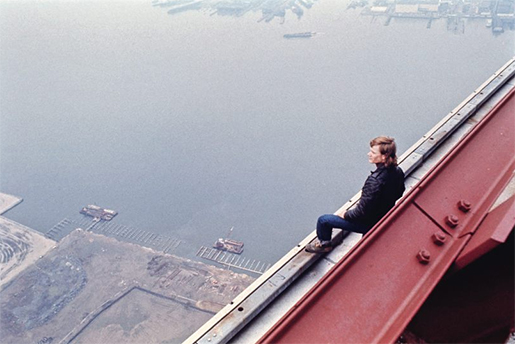
The documentary Man on Wire recounts a French tightrope walker’s obsession to tread while suspended between the void of the World Trade Center Towers 1,368 feet from the ground. That’s the height of 228 six-foot men. Having trained for most of his life to perform this feat, he masterminded a plot with an adventurous team of experts and thrill-seekers to infiltrate the towers’ rooftops to get the wire across them. The illegal operation was as dangerous and complex as a robbing a heavily guarded infrastructure like in Jules Dassin’s Rififi (1954) or, if you haven’t seen that one, Steven Soderbergh’s 2001 remake of Ocean’s Eleven. My only complaint about the break-in was that they didn’t pack a video camera to film the spectacle from such an awesome perspective view.

The scenes of the controversial incursion are narrated by the present interviewees while documented footage and dramatically staged footage bring us intimately to experience it. The black-and-white footage (always timeless) is integrated so well that documentary and the fictional realization become seamless. The director James Marsh has made an exceptional thriller and a visual poem about great dreamers whose vision threaten to capsize them unless they rise to act upon their desires.

This is a superb follow-up to Marsh’s 2006 directorial debut titled The King, a chilling docudrama about an estranged son (Gael Garcí­a Bernal) who goes to depraved lengths to integrate himself into the new family of his born-again father (William Hurt – “How does that feel?”). The King was between Julia Kwan’s Eve and the Firehorse and John Hillcoat’s The Proposition on my Best Films of 2006 list. This year, Marsh is almost neck-to-neck with magician/filmmaker Errol Morris who too has made another invaluable documentary called Standard Operating Procedure. CONTINUE READING ►

Movie Review: THE DARK KNIGHT (2008)

by Christopher Beaubien • July 22, 2008 • Start the Discussion!

Gotham’s Finest! Consequently, also its bleakest.

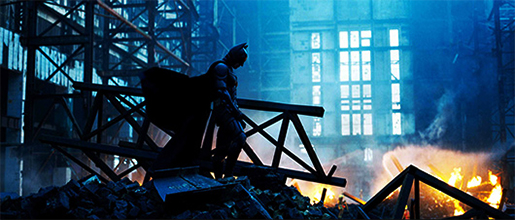
I wept throughout the last two minutes of The Dark Knight and applauded rapturously throughout the end credits. This is the Batman movie I have been waited for ever since I discovered the Batman comics at the age of five. It is unrelentingly grim; however, it is also very optimistic because the power of good, slight as it is, glows against the darkness. When hopelessness engulfs its victims, true heroism at its most intangible and mysterious can shine in the corridors of the heart. Here, sacrifice is the key to combat such harrowing evil. I love exhilarating tragedies. This film has a prominent place on my list of the best films of the decade alongside the Dardenne Brother’s Le Fils (2003), Paul Thomas Anderson’s There Will Be Blood (2007), Nicole Holofcener’s Lovely and Amazing (2002), Guillermo del Toro’s Pan’s Labyrinth (2006) and Mike Nicols’ Wit (2001). I love this movie so much that, despite the obvious legalities attached to this proposition, I want to ask Christopher Nolan’s permission to marry his movie.

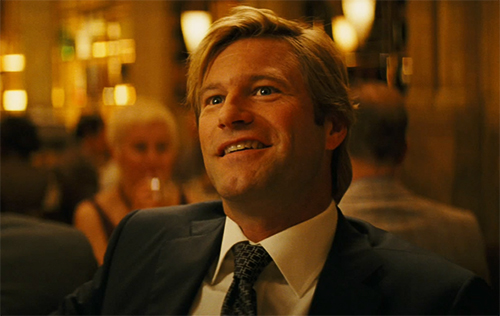
In terms of on-screen performances, I’d like to do something rather radical, and focus on the work of Aaron Eckhart as Harvey Dent first. My first confrontation with Eckart was as Chad, the all-too-credible venomous charmer in Neil Labute’s In The Company of Men (1997). In that film, Chad persuades his pal Howard (Matt Malloy), an earnest lemming, while on their business venture out of town to play a cruel joke on a pretty, deaf woman (Stacy Edwards). It was a small masterpiece about how a sterile, corporate environment breeds nihilistic alpha males, nebbishes and their victims. Eckhart’s work was phenomenal in depicting misanthropy with such unnerving — in the worst sense of the word — humanity. This was a character actor to watch out for.

Throughout the last ten years, I’ve seen him shine in the corners of Your Friends and Neighbors (1998), Nurse Betty (2000), The Pledge (2001), and Conversations with Other Women (2005). Finally, Jason Reitman cast Eckhart as an earnest tobacco lobbyist in Thank You For Smoking (2005), which launched him into the mainstream as a leading man who could dive in the taboo stream (“It is in our best interest to keep Robin (Cancer Boy) alive and smoking!”) and retain his likability – he could smile his way through manslaughter if he wanted.

As Gotham City’s new White Knight, District Attorney Harvey Dent, Eckhart has finally delivered an astonishing performance in a mainstream blockbuster. Eckhart is so good that he deserves nomination talk along with Heath Ledger, who I will write about later. Throughout the first half of the picture, Eckhart is perfect as the passionate, though moody D.A. with his brooding forehead and easy smile. So eager to hang up the cape, Batman (Christian Bale) looks to Dent as a fearless crusader, his equal minus the mask, who could take down the mob and return Gotham to form. They both give one another strength like yin and yang: “You can’t quit!” Dent is a man who would rather face on powerful criminals in court (“I haven’t finished question him, your honor!”) than hobnob alone with stuck-up socialites at his re-election fund raiser. He simply prefers to make his own fate.
CONTINUE READING ►

Movie Review:
THE COOK, THE THIEF, HIS WIFE & HER LOVER (1989)

by Christopher Beaubien • July 06, 2008 • Start the Discussion!

Served Scolding, Heavily Trysted, and Blood-Thirsty!

This sumptuously lurid play, by Peter Greenaway, on depravity, sexual oblivion, and Jacobian revenge remains the most accessible and compelling in his filmography. It is also one of the few films I hold closest to my heart. The Cook, The Thief, His Wife & Her Lover (1989) is simultaneously simple and deceptive beginning with the film’s title. The main characters could stand for an angry allegory about greedy Thatcher-inspired bullies exploiting the working class citizens of Britain. Then again, perhaps this tale of excess, rape, and cannibalism is a heightened account about deeply wounded souls.

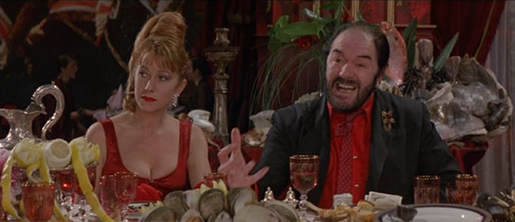
Le Hollandaise is a grotesquely bourgeois restaurant where the thief Albert Spica (Michael Gambon, Gosford Park, 2001), his wife Georgina (the indispensable Helen Mirren, Gosford Park and Last Orders, 2001), and his goons (Tim Roth and Ciarán Hinds) dine every night. We are introduced to Albert as he force-feeds a lowly member of the kitchen staff owing money his excrement, and elaborating on its value: “I eat the very best and that’s expensive!”

The cook, Richard Borst (Richard Bohringer, Diva, 1981) stands up to the thief’s boorish threats concerning his offered “protection” with a collected reserve that masks deep rage – “If you button your expensive jacket, Mister Spica, you feel less…empty inside, Mister Spica.” Seated in the center of the operatic dining room, Albert’s hostility extends toward everyone around him, including the patrons. Georgina, who Albert crudely dubs, “Georgie”, often berated and beaten by her husband, is quietly defiant. She makes eye contact with Michael, a quiet intellectual (Alan Howard, The Lord of the Rings: The Return of the King, 2003) as he eats and reads in the corner. Their infatuation leads to many excuses for a rendezvous in the opulent lavatory, where she and tender, love-handled Michael make desperate, explicit love as a means of escape.

Their sexual escapades take them behind closed doors in the kitchen, a secret quietly kept by the restaurant’s workers. Albert, obvious to being a cuckold, continues displaying his virtuoso nastiness with loud, arrogant (and darkly hilarious) commentary punctuated by violence: “I think Ethiopians like starving!” and “Human milk should be considered a delicacy.” Everyone around him is reduced to frightened submission. One night, he invites Michael to his table where he picks on his reading habits, “Does this stuff make money?” After having badly-bruised Georgina dictate how wonderful her life is (“Tell Michael you live in a big house and you spend a thousand pounds a week on clothes!”), she retaliates with news about her gynecology appointments (“Being infertile makes me a safe bet for a good screw.”) Albert drags her across the parking lot for that one. CONTINUE READING ►

Movie Review:
BEFORE THE DEVIL KNOWS YOU’RE DEAD (2008)

by Christopher Beaubien • May 09, 2008 • Start the Discussion!

before_dead

A New Simple Plan

Watching (May You Be In Heaven Half an Hour) Before the Devil Knows You’re Dead again, I was reminded what an inciting filmmaker legend Sidney Lumet is. His directorial resume strikes me with awe: 12 Angry Men (1957), Dog Day Afternoon (1975), Network (1976), Q&A (1990). In 2005, the Academy Awards honored Lumet with a Lifetime Achievement Award after being nominated for five awards in the past. Three years later at the age of 83, Lumet just makes another masterpiece as if it were easy.

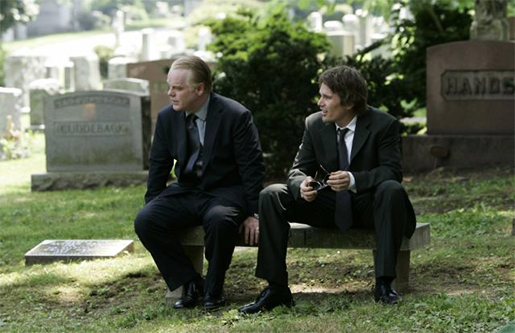
Now I have to tread carefully here because there are many revelations you should discover for yourselves. The film stars Philip Seymore Hoffman (Happiness, 1998) as Andy, a dominating businessman over Hank, his feckless brother played by Ethan Hawke (Before Sunset, 2004). They both need money desperately. Andy is caught in a vicious grip of drug use to cope with his rocky marriage and the money he is embezzling from his company to feed his habit. Hank, a pretty boy gone to seed, is way behind on alimony payment and is paralyzed by fear that his little girl will despise him as much as his ex. Marisa Tomei (Slums of Beverly Hills, 1998) plays Andy’s wife Gina who displays her body vindictively and suffers from personal demons.

In his office, Andy just about towers over Hank as he proposes a way to get some easy money by robbing a jewelry store, “a mom and pop operation”, one Sunday morning. In one of many chilling moments, Hank is hunch-shouldered and all twitches as he points out, “Andy — that’s mom and dad’s store”. Andy smiles, “it’s perfect.” They know the combinations to the safe. The woman opening the store is practically blind. Get in and out. Their parents are insured. No one gets hurt. It’s perfect!

CONTINUE READING ►

Movie Review: IN BRUGES (2008)

by Christopher Beaubien • April 20, 2008 • 2 Comments

inbruges4

Murderers… Twisting and Turning… in a “Fairy Tale Place”…

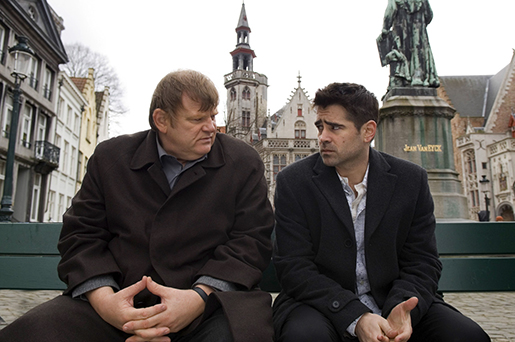
In early February 2008, the debut of writer-director John McDonagh floored me. In Bruges started a trend following David Fincher’s Zodiac in 2007 that at least one movie released in February was a masterpiece. What surprised me most about this gutsy film was how elegantly it focused on two Irish hit men from London. The youngest is Raymond (Colin Farrell), a cocky bloke who comes across as curt to others (“You’re a bunch of fucking elephants!”), but he isn’t mean-spirited, just thoughtless. Ken (Brendan Gleeson), a jovial soul masking a deep sadness, accompanies Raymond as his mentor in their line work and acts in some ways like a surrogate father figure. In a moment of great duress, Ken breaks the silence by reassuring Raymond, “You look good.”

For perhaps the first time in Raymond’s life, he is affected by gnawing guilt over an unforgivable accident he caused. His manic depression has made him suicidal. Their relationship is a fascinating because Farrell and Gleeson work so effortlessly together. A comradery of wit, pain and compassion. Killing for hire to Ken is surmised simply, “It’s what I do.”

Their boss Harry Waters (Ralph Fiennes) sends them away to hide in Bruges (“It’s in Belgium.”) after the last job got botched. With his nose in the guide book, Ken explains that “Bruges is the most well preserved medieval town of all of Belgium apparently.” On a wintry canal ride, Ken marvels at the old buildings and churches while Raymond sits with his shoulders hunched, bored out of his mind. Here Bruges is a setting closest to one can ever get to purgatory on Earth. It’s a perfect stage for these killers to reflect and act upon their trespasses. At one point in the Basilica of the Holy Blood, Ken accuses Raymond of “Throwing a fucking moody like a five-year-old who’s dropped all his sweets!”

While standing before Hieronymus Bosch’s oil painting The Garden of Earthly Delights, Raymond is compelled to ask Ken about his views of the afterlife. Ken is at a loss of words at first. A lesser movie would have moved on from there. Instead, we go outside where Ken honestly tries to answer Raymond’s questions. It is a perfect scene. Note how Raymond demonstrates his self-interest when he speculates about a boy never able to go to Bruges and says “I don’t know why.” These characters are so well-written that their own point-of-view is always evident.

CONTINUE READING ►