CINELATION | Movie Reviews by Christopher Beaubien
Subscribe
Rainbeau Creative
HAL 9000

Platinum

Movie Review: INCENDIES (2011)

by Christopher Beaubien • January 28, 2011 • Start the Discussion!

Platinum

The Elegance and Dread of an Equation

Nawal Marwan is dead. She is survived by her twin children Jeanne and Simon, both in their late twenties and living in Montreal. They sit before the notary Jean Lebel (Rémy Girard) who had employed Nawal (Lubna Azabal) as his secretary for years. He has always considered them all to be a part of his family. The room is still and unbearably quiet. As he reads Nawal’s final will and testament aloud, Jeanne (Mélissa Désormeaux-Poulin) and Simon (Maxim Gaudette) are disturbed by their mother’s final request. She wants to be buried naked facing the ground without a headstone to identify her. Where did this self-loathing come from? Jeanne keeps her composure and listens. Simon goes berserk over how cold and insane their mother was. He will not respect her wishes.

Professionally bound to secrecy about Nawal’s mysterious past, Jean emphasizes how grave this situation is: “Childhood is a knife stuck in the back of your throat. It cannot be easily removed.” Nawal will only accept a dignified burial on the condition that Jeanne and Simon accomplish a mission to redeem her. Two sealed letters lie on the notary’s desk. One is addressed to their estranged father whom they’ve thought was dead. The other one is news, a long-lost brother who was named “Nihad of May”. Their task is to find and then deliver their letters to them. Simon refuses to participate. After some soul-searching, Jeanne sets off to discover what regrets her mother had kept silent.

We cross back and forth between the divide of Jeanne’s daunting search and Nawal’s past. It is striking how much the two women resemble one another. Their determination and resolve is matched by their ethereal, solemn beauty. Their paths are separated only by decades as Jeanne follows her mother’s footprints in Lebanon from the North to the horrors in the South. For every startling chapter that closes on Nawal’s life, Jeanne comes much closer to solving the mystery. The question of ever figuring it out turns into another one supplemented by a great reluctance akin to rolling over a rock to expose the maggots underneath.

CONTINUE READING ►

Movie Review: THE WRESTLER (2008)

by Christopher Beaubien • February 02, 2009 • Start the Discussion!

thewrestler1

A Punishing Character Study

One of the most painful moments in The Wrestler is when the doctor explains to Randy “The Ram” Robinson (Mickey Rourke) after his heart attack that he must not exert himself. The aging, muscular man is devastated and cries out, “Doc! I’m a professional wrestler!” The key word there is professional. He takes it seriously. It defines him. Being stripped of his identity, Randy feels worthless. He has never thought about the long term. His lost years of celebrity, drug use and promiscuity left him devoid of anyone who really care about him. Now, Randy is finally going to feel the emotional punishment he has spent his life numbing by punishing himself in the ring.

Why do I love Randy “The Ram” Robinson? Because after sleeping in the back of his van, he has the good spirit to humour the kids knocking outside his window with some horseplay. Because he is a good sport when he choreographs a wrestling match involving a staple gun being used on him. Because he really does love Cassidy (Marisa Tomei), that sweet woman who works at the strip joint he often frequents. Because he is a good sport when he choreographs having a staple gun used on him during a match. Because when Randy picks out a jacket with the letter “S” for his justifiably resentful daughter Stephanie (Evan Rachel Wood), he really thinks she’ll like it. Because Randy hates himself for screwing up the good things that come his way. I can’t hate a man who already hates himself so much.

Mickey Rourke plays this character as if he atoning for sins for which he cannot forgive himself. Watch how Rourke has Randy force himself to smile and not cry when Cassidy swills the rest of her beer down. Sizing up Rourke, Marisa Tomei as Cassidy stomachs so much pain here, whether she exposes her body and is passed over by customers or how she just can’t bear to watch Randy punish himself. Back in 2005, Rourke played a brutish lug named Marv in the comic-adaptation of Sin City. That character’s dialogue and scarred face were the stuff of pulp. Marv is an extension to Randy, a very sad avenger who nurses romantic fantasies. The closest Marv gets to a confession is when he confides his trouble with love. “I couldn’t even buy a woman… the way I look.” Mickey cut a big slab of himself off that meaty character and named him “The Ram”.

CONTINUE READING ►

Movie Review: MILK (2008)

by Christopher Beaubien • December 16, 2008 • Start the Discussion!

milk_film3

Vote for Harvey Milk (1930 – 1978)

The passing of Proposition 8 across the United States two weeks ago adds more urgency to the new Gus Van Sant film Milk. It is a red alarm crying out against the continued and criminal persecution of homosexuals. Denying the civil rights of an individual to legally marry a person of their choice is cruel. For decades, sanctimonious hypocrites have relentlessly imposed their prejudice on homosexuals, forcing them to live in the margins of society. Homophobia has always puzzled and irritated me. When I was seven, before I was aware of gays and lesbians, I casually wondered if there were men who loved men and women who loved women. Later I found out my musing was correct – and like looking up at the sky to see birds were flying up there — I was cheered by the prospect. As a level-headed straight man, I support and empathize with good people like Harvey Milk.

CONTINUE READING ►

Movie Review:
SYNECDOCHE, NEW YORK (2008)

by Christopher Beaubien • November 11, 2008 • 2 Comments

The Life Stages of Caden Cotard

Oh God, I feel alone. I feel so utterly alone having connected and clicked with a film that many people will reject. This being the directorial debut of the incomparable screenwriter Charlie Kaufmann: Sï-nêk’dõ-kë, Nyöo Yáwrk. For me, Synecdoche, New York is a tough sell — an unconventional film that I treasure where recommendation demands caution. It’s where I stand with Béla Tarr’s Werckmeister Harmonies (2000), Lars Von Trier’s Breaking the Waves (1996), Bill Forsyth’s Housekeeping (1987) and Robert Altman’s Three Women (1977). These films fly in the face of all the formulaic and commercial creeds of how a movie should work and gives pause for how many ways it could work best. A first impression might grimace, conclude “it’s weird” and close the investigation — that’s their right; however, Synecdoche, New York deserves better and an appreciative audience. The film works, not despite, but because of its extraordinary structure and function being mysterious, opaque, labyrinthine, yet emotional, accessible, and fully-formed.

What I love most about Charlie Kaufman’s exercises in the celluloid medium is how they exceed expectations throughout his most unorthodox and dizzying narratives. Throughout, there is apt teasing and suspense over where this story could go when driven by such a visionary. By the end, I feel as if he has exhausted every possibility from his premises with an attentive heart. Such as when the pitiable Craig Schwartz whose puppets of himself and Maxine, a distant female co-worker, kiss for the first time in Being John Malkovich (1999). Or when Joel Barish frantically races away from his evaporating memories with his ex-girlfriend Clementine at hand, trying to save her in Eternal Sunshine of the Spotless Mind (2004). Or how about when in Adaptation (2002), New Yorker writer Susan Orlean is struck by the awesome poetry of John Laroche, a toothless orchid thief, musing about the “little dance” between wasps and orchids — “How, when you spot your flower, you can’t let anything get in your way.”
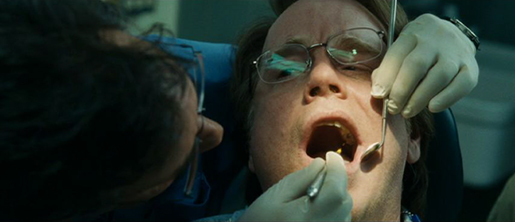
In Synecdoche, New York, our hero tries to find meaning in his very existence by resurrecting an evolving metropolis in a gigantic sound-stage where a flock of birds fly off many miles down the structure. The seminal replica of Manhattan is a theatre set for an untitled play about its director and all of the people in his life. Since the play reflects life, so the play must reflect itself like a microcosm that expands, refracts, grows and deepens. It is a comic-tragic, universal illustration of a life that tries to manage its surrounding citizens in roles (wife, daughter, mistress, 2nd wife, etc.) the participant tries to contain. Of course, everyone else is the lead in their own story, so management of the play of one’s life becomes discombobulated.

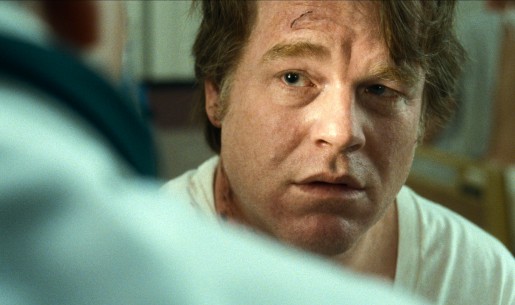
Enter the world of theatre director Caden Cotard played with great nerve and without vanity by Philip Seymore Hoffman. At age forty, he is burdened with anxiety, bad health, failed relationships, and occasionally distracted by lofty goals that feed his great ego which barely hides his low self-esteem. Like an addict, he mercilessly prods, analyzes and compresses his failures; denying himself a much wanted recovery by purging himself deeper into a sea of emotional toxin. What hurts most is that he tries so hard to preserve what little he has left. While a doctor sews stitches into his forehead after a freak accident with an exploding sink faucet, Caden sheepishly remarks, “I’d rather there not be a scar.”

CONTINUE READING ►

Movie Review:
LET THE RIGHT ONE IN (2008)

by Christopher Beaubien • November 08, 2008 • 2 Comments

ltroi1

Rare, Bloody and Tender

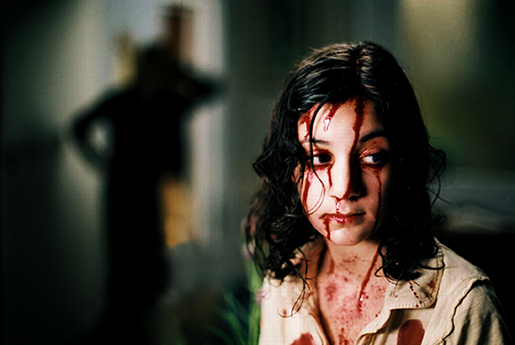
First, I would like to single out a scene that is pivotal to the overall success of Let the Right One In. Oskar, a twelve-year-old Swedish boy (Kåre Hedebrant), whose parents are separated, is visiting his father (Henrik Dahl) over the weekend. Late in the night, the two are having a blast playing tic-tac-toe. They are interrupted by a visitor whose presence subtly changes the course for the rest of the evening. The last grim exchange between the father and son expresses so much hurt and understanding about the how and why. It doesn’t need to be explained. It is simply felt. This scene sounds like it belongs in a serious drama. It is, but Let the Right One In is also a vampire movie – as sophisticated and thoughtful a horror film as you are likely to find.

This film, like so few can, redeems the horror genre. So many cynical filmmakers belittle their horror films because they don’t believe the genre is worthy. You can browse shelves of horror titles and find only one success out of thirty failures. Thankfully, Let the Right One In joins the ranks of great vampire films like Kathryn Bigelow’s Near Dark (1987), both of the 1922 (dir. F.W. Murnau) and 1979 (dir. Werner Herzog) versions of Nosferatu, and its cunning companion Shadow of the Vampire (2000) by E. Elias Merhige. Let the Right One In is the real thing. Set in Sweden – 1982, it uses vampire logic in an environment as cold, cruel and recognizable to our own. There are moments of invention such as what happens when a vampire trespasses property where an invitation has not been given. Here, vampires get burned when touched by sunlight – they don’t (*shudder*) sparkle.

ltroi5Living next door to Oskar is Eli (Lina Leandersson), a young vampire who looks like a twelve-year-old girl, but it is more complicated than that. There is an alarming shot of her behind a door that’s ajar — you know the one. She is sheltered by an older deviant (Per Ragner) who appears to be under a spell as he fetches her blood from victims he kills and drains. She would have been better off sending the Ice Truck Killer to perform this task. Upon further reflection, this character may be a possible outlook into the future of what Oskar will become when he reaches adulthood.

CONTINUE READING ►