CINELATION | Film Reviews by Christopher Beaubien
Subscribe
Subscribe

Archive for February 2009

“Coraline” Review

February 23, 2009 | Film Reviews, Reels: 4.5/5 | By Christopher Beaubien

coraline6

A Grimm Girl Enters A Grim World…

When I say “The Nightmare Before Christmas”, what is the first name that comes to mind? Tim Burton. Burton invokes visions of dark whimsy, and promises tours into a world that is distinctly his own. From the visual style and original story based on Burton’s illustrated book to his entire filmography coined a word that solely attributes to the artist and his world — Burtonesque. Hell, his name is in the title: Tim Burton’s The Nightmare Before Christmas. It takes a few more synapses in the brain to remember that Henry Selick was the film’s director. Selick made Jack Skellington come to life. Even the association of Burton as a producer blurs Selick’s accomplishment for his 1996 film James and the Giant Peach, based on the Roald Dahl novel. Finally, Burton is absent working on his adaptation of Alice in Wonderland due 2010. Selick is all alone here with the adaptation of Neil Gaiman’s Hugo Award winning novel.

Coraline is Selick’s baby.

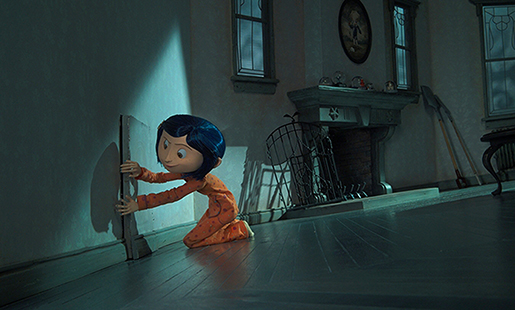
11-year-old Coraline (Dakota Fanning) is an intelligent, waifish girl with dyed ink-blue hair. She has a bright, funky wardrobe including a loud, yellow raincoat and striped stockings. To her, the thought of attending a private school where she’d have to wear a grey uniform like everybody else is like opening her skull and smearing mud on her brains. Some may consider Coraline to be a little snot. She had my sympathies the second her face turned into a sour sneer. I could relate. I was easily peeved as a kid, and viewed authority skeptically. Most of my childhood felt like I was holding my breath, waiting for the smog to clear. I enjoyed my own pursuits, and had little interest in being “a good sport” about constantly being IT in games of Tag, among other childhood indignities. What gets Coraline through the day are her explorations outside on overcast afternoons, decorating with vibrant colours, and missing her friends after moving from Michigan into the deep woodlands.

Her precociousness clashes against the few eccentric denizens living in the rented levels of the Pink Palace Apartments. Mr. Bobinsky (Ian McShane), a blue-skinned, potbellied Russian vaudevillian trains mice for his small circus on the top floor. In the basement, one stout Miss Spink (Jennifer Saunders) and one very buxom Miss Forcible (Dawn French) are retired acrobats whose personalities might remind those Pushing Daisies fans of The Darling Mermaid Darlings. The designs of these two old crones were likely inspired by the characters Aunt Sponge and Aunt Spiker in Selick’s James and the Giant Peach (1996). The two provide Coraline with handy tea-leaf readings and decades-old sweets. The odd boy next door named Wyborn (Robert Bailey Jr.) – “Why were you born?” – is a motor-mouth whose steady steam of chatter rivals his own dirt bike. The poor kid’s awkwardness is amplified by his hunchback and skewed head. Unfortunately for him, Coraline isn’t a very empathetic person — a universal trait shared amongst most children. He just gets on her nerves.

(more…)

Shirley Walker’s Contribution to “Apolcalypse Now” (1979)

February 09, 2009 | Commentary, News | By Christopher Beaubien

shirley_watercolour

Before becoming the next best thing to the likes of film composer Danny Elfman, Shirley Walker made her mark as a conductor for a few renowned films such as Randa Haine’s Children of a Lesser God (1986) and Jonathan Kaplan’s The Accused (1988). Her greatness was matched by the production of Francis Ford Coppola’s Apocalypse Now (1979) as her first gig in Hollywood. On the Internet Movie Database, Walker is listed as a synthesizer musician in the film’s music department. The original music credit goes to its director (listed as Francis Coppola) and his father Carmine Coppola. Coppola’s wife, Eleanor, was too busy documenting its production with stunning material that would later become Hearts of Darkness: A Filmmaker’s Apocalypse (1991), written and directed by Fax Bahr and George Hickenlooper who also made the wonderful film, The Man From Elysian Fields (2001). Like Werner Herzog’s Fitzcarraldo (1982) and its accompanying documentary Burden of Dreams (1982), Hearts of Darkness presents the production as harrowing an experience as Apocalypse Now.

2008 was a year to be a fan of Batman; not only did The Dark Knight raise the bar of action pictures involving anti-heroes, but after over a dozen years of waiting, some of the exemplary score from Batman: The Animated Series (1992-1995) was finally released on commercially sold CDs. This first volume is an accumulation of music by head composer Shirley Walker and collaborations by the equally good musicians Lolita Aitmanis and Michael McCuistion. Yes, I bought one of the three-thousand limited releases and it has a place of honor in my office. I investigated Shirley Walker’s 1979 case after reading this excerpt from the collectible booklet included with the soundtrack:

In the 1970′s, Walker began scoring industrial films and jingles while continuing to play as apianist with a variety of orchestras. With one of the Bay’s hotbeds of creativity being Francis Ford Coppola’s American Zoetrope Studios, Walker’s notoriety would see her join the musical team of the writer-director’s Apocalypse Now in 1979. Her synth playing was a major factor in helping Coppola’s father Carmine realize Apocalypse Now‘s acid rock groove, and Walker would re-team with Carmine that same year for The Black Stallion, charging to the rescue with additional music for the Coppola-produced family classic.

-Daniel Schweiger, a soundtrack editor for iFmagazine.com and Venice Magazine.

Exhibit A:

“You’re in the asshole of the world, Captain!”

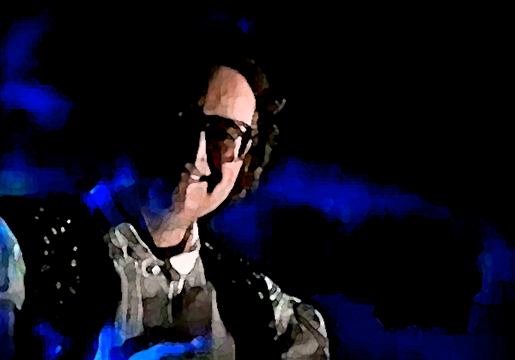
apocolypseMy favorite twenty seconds of Apocalypse Now‘s entirety is comprised from 2:59 to 3:19 in the following Do Long Bridge sequence. Captain Benjamin L. Willard (Martin Sheen) and his acid-tripping soldier Lance B. Johnson (Sam Bottoms) march across the wire-protruding, burnt-black terrain erupting with explosions of hellfire. From the center of a shooting post, descending lines of light bulbs stretch beyond the inky background and toward the frame panning horizontally to the right. Accompanying the commands, screams and growls on the soundtrack, the surrealistic music kicks in and drowns out the noise, effectively smothering it. The best way to describe the music would be like a carnival pavilion vomiting bile and severed elephant parts. If I died and heard this music, then I will know that I am really in Heaven. I love this music!

Exhibit B:

At this point of The Clock King episode, Batman is locked in a bank vault rigged to suck all of the oxygen from the room. Nearly unconscious, Batman’s point-of-view reveals a digital read-out box from a distance going in and out of focus as opposed to the steel door of the vault. Starting at 4:21 of episode track (not included on the CD…the next one, maybe?), listen for blaring synthesizers from 4:26 to 4:31. Sound familiar? The achieved effect of those nauseous sounds is identical to those used for the Apocalypse Now track. My conclusion is that Shirley Walker is directly responsible for why I regard that scene of Coppola’s film so highly.

jokersfavorListening to those inspired, sinister tracks from Batman: The Animated Series always brings me back to my childhood. Where else has a theme for Batgirl (4:22 – 5:11) sounded so celebratory, bouncy, rousing and yet threatening? Okay, that is the music I want to hear before those illusory golden gates open before me. What other music makes the Joker (1:43 – 2:35) sound like a balance between lunacy and satanic hedonism? I refer to this soundtrack release as Volume One because there is a big demand for the rest out of the sixty-five episodes of the series. I want to listen to a pure orchestrate of virginal tracks from episodes ranging from Read My Lips, Mudslide, and Shadow of the Bat to House of Garden, Harlequinade, and BabyDoll. Oh, and I haven’t forgotten about the music from The New Batman Adventures (1997-1999), like Over The Edge, Growing Pains, and Mad Love. Surely, about a dozen more volumes isn’t out of the question. So far the first release is an excellent start on part of its producers to do justice to the late, great Shirley Walker.

“The Wrestler” Review

February 02, 2009 | Film Reviews, Reels: 5/5 | By Christopher Beaubien

thewrestler1

A Punishing Character Drama

One of the most painful moments in The Wrestler is when the doctor explains to Randy “The Ram” Robinson (Mickey Rourke) after his heart attack that he must not exert himself. The aging, muscular man is devastated and cries out, “Doc! I’m a professional wrestler!” The key word there is professional. He takes it seriously. It defines him. Being stripped of his identity, Randy feels worthless. He has never thought about the long term. His lost years of celebrity, drug use and promiscuity left him devoid of anyone who really care about him. Now, Randy is finally going to feel the emotional punishment he has spent his life numbing by punishing himself in the ring.

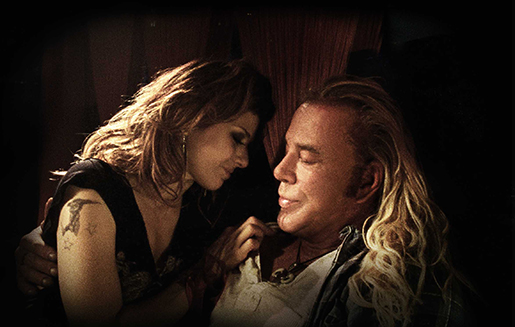
Why do I love Randy “The Ram” Robinson? Because after sleeping in the back of his van, he has the good spirit to humour the kids knocking outside his window with some horseplay. Because he is a good sport when he choreographs a wrestling match involving a staple gun being used on him. Because he really does love Cassidy (Marisa Tomei), that sweet woman who works at the strip joint he often frequents. Because he is a good sport when he choreographs having a staple gun used on him during a match. Because when Randy picks out a jacket with the letter “S” for his justifiably resentful daughter Stephanie (Evan Rachel Wood), he really thinks she’ll like it. Because Randy hates himself for screwing up the good things that come his way. I can’t hate a man who already hates himself so much.

Mickey Rourke plays this character as if he atoning for sins for which he cannot forgive himself. Watch how Rourke has Randy force himself to smile and not cry when Cassidy swills the rest of her beer down. Sizing up Rourke, Marisa Tomei as Cassidy stomachs so much pain here, whether she exposes her body and is passed over by customers or how she just can’t bear to watch Randy punish himself. Rourke found his match with director Darren Aronofsky who has overseen some searingly painful depictions of human agony in films like Pi (1998) and Requiem for a Dream (2000).

Aronofsky tones down his trademark visual kinetics and opts for a documentary aesthetic. The scene where Randy gets treated for each injury and we double back to the previous fight to see how he got it was a gutsy inspiration. The Wrestler is well photographed by Maryse Alberti whose camera finds interesting angles like that establishing shot outside the supermarket with a parking lot lamp at the right side that looks too close for comfort. The camera work is mostly hands-on, deprived of luxuries like tripods and cranes, we become ingrained in the sluggish velocity of Randy’s days. The wavering framing of Randy leaving the hospital in long shot is the most prominent example here. As a loving tribute, from the finger-smudged photographs to the retro font of the main title sequence expresses vintage 1980s sensibilities when Randy was in his prime.

I am drawn to movies about people living close on the edge. The Wrestler is a demanding and devastating experience.