







“Wendy and Lucy” Review

Compelling Take On A Girl And Her Dog
Quietly, slowly and efficiently, writer and director Kelly Reichardt observes Wendy (Michelle Williams), a young runaway disenchanted with her life back home and who is dangerously close to becoming a drifter. Invisible to those around her, she is accompanied by Lucy, her golden retriever. She also wants to find work in Alaska. Wise choice: the fish canneries do pay well. The two sleep in her car. Her budget is really tight. Now her car won’t start. Over the next few days, she is stranded in a nearly desolate Portland, Oregon town where she curtly explains to strangers: “I’m just passing through.” With many miles left to go and too far away to go back, Wendy is determined to stick to her plan.
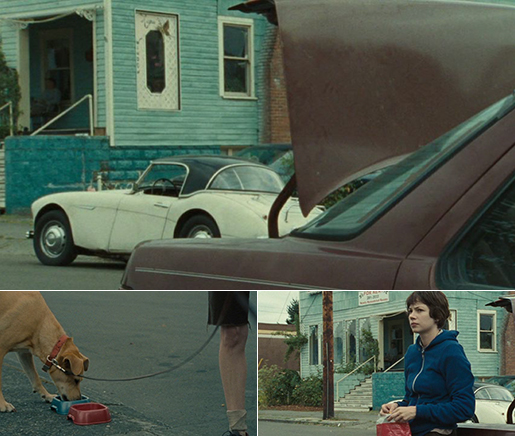
In a wonderful shot early one morning, Wendy lugs out a nearly empty extra-large bag of dog food out of her car to fill Lucy’s bowl near a suburban curb. Under an overcast sky, the shot stays with Wendy and then she leaves the frame. From a low-angle, we observe a line of modestly kept homes at a distance. There is someone sitting in one of the porches looking back at us. Who is this person? Is this important to the plot? Where’s the movie star? This is a waste of money! The studio notes would have been endless had this not been an independent production outside the studio system. Wendy does come back into the frame. The means of losing her momentarily demonstrates just how easily she could slip right through the cracks and never be seen again.

Michelle Williams is a chameleon — she shreds all semblance of her earlier, more glamourous roles. All that’s left is Wendy, fresh-scrubbed, a haircut from home and eternally clad in plaid shirts and faded jeans. Is this really Jen from Dawson’s Creek? Now, Wendy is distraught and apologizes to her dog for the few crumbs she able to offer. Then she goes to the supermarket a few blocks down. When currency-conscious Wendy decides to steal a few items from the store, I was really touched by what she left behind in the store. (more…)


What Mike Leigh most enjoys is playing with our perceptions of people. We are wired to make assumptions by the initial impressions of our casual acquaintances and strangers who enter our field of vision. Sometimes our hunches are right (to each his own) and most times we are mistaken. Notice what Leigh shows us about Poppy. She has a sense of humour. She’s earnestly social. She goes clubbing with her friends all-night on Saturdays. She’s not afraid to look silly. At the point she is making bird masks with paperbags and colourful felts and feathers, Leigh is practically goading us to see her as a “bimbo”, while giving those who are onto Leigh’s game just enough leeway to hold their verdicts. How this plays out reveals the real themes of Happy-Go-Lucky. What do we really know about one enough? How do we learn to see people for who they are? What makes a good teacher?
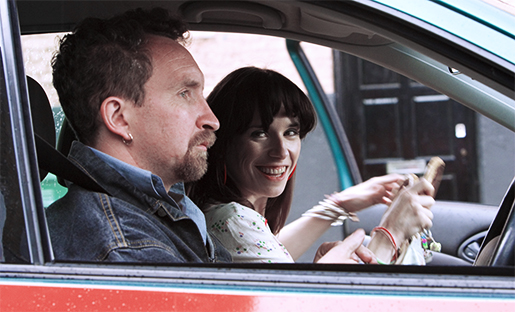
Eddie Marsen is brilliantly ruthless playing Scott as the kind of man who is forever blaming everyone around him. You’d almost pity him if he wasn’t so irredeemably clingy to his prejudice. He is resigned to his rut. What bitter irony that his job description tempers road rage. He even screams at his pupil. Mike Leigh has dealt with a similar character in his most bleakest film Naked (1993) — its title character Johnny, played by David Thewlis, was a scuzzy intellectual who aimlessly drifted into the lives of others only to hurt them. Scott has a way of revealing deep emotional scars with silence. One imagines he privately picks at his insecurities like a scabby wound that will never heal. Like Johnny, he uses his book smarts to conceal his hostility to others. Worse, he is set off with fright and hostility when he sees two black teens bicycling across the street. “Lock your door!” What a toxic man.