






“Milk” Review

Vote for Harvey Milk (1930 – 1978)
The passing of Proposition 8 across the United States two weeks ago adds more urgency to the new Gus Van Sant film Milk. It is a red alarm crying out against the continued and criminal persecution of homosexuals. Denying the civil rights of an individual to legally marry a person of their choice is cruel. For decades, sanctimonious hypocrites have relentlessly imposed their prejudice on homosexuals, forcing them to live in the margins of society. Homophobia has always puzzled and irritated me. When I was seven, before I was aware of gays and lesbians, I casually wondered if there were men who loved men and women who loved women. Later I found out my musing was correct – and like looking up at the sky to see birds were flying up there — I was cheered by the prospect. As a level-headed straight man, I support and empathize with good people like Harvey Milk.
Keith Olbermann’s “Special Comment” from MSNBC Countdown
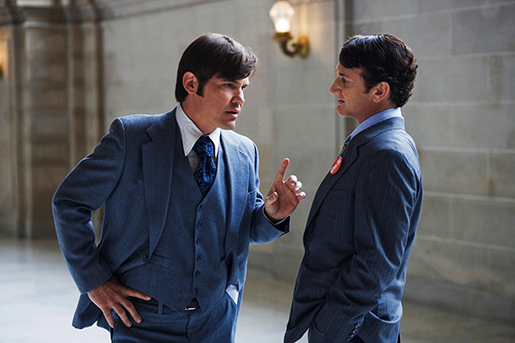
Gus Van Sant has made the most compelling biopic since Bennett Miller’s Capote (2005) – a close second is David Fincher’s Zodiac (2007) about Robert Graysmith’s obsessive investigation for an infamous serial killer. All of these films avoid the wearisome narrative trap that checks off the birth, the childhood a la Taylor Hackford’s Ray (2004). Close attention is paid to set us in this very specific time and place from 1970 to 1978 in Castro, San Francisco. For anyone unfamiliar with Harvey Milk (Sean Penn), the film reveals in its first few minutes that the man was assassinated in the late 1970s along with Mayor George Moscone (Victor Garber). The film seamlessly combines documented footage from the 1970s into the staged fiction with success much like Mary Harron’s The Notorious Bettie Page (2006). Even Milk, the first openly gay man elected in government as a city supervisor, realized his imminent death was soon approaching. Late one night, he recites his memoirs on a tape recorder in his kitchen. We come back to Milk and his mike throughout his story; his words illuminate events after the fact like an angel reminiscing until he has to stop.
Forty-year-old Harvey Milk, a closeted gay man working like a cog for a corporation, was dissatisfied with his life. Upon a chance encounter on the steps of a New York subway, Milk coyly picks up a thirtyish sweet-faced hippie named Scott Smith (James Franco, very good here). The two men light up as they fall comfortably in love. It is a great pleasure to watch their warm and attentive romance – these people are happy together. Eventually they immigrate to San Francisco where they still face open hostility and are not welcomed in stores. As a Goldwater Republican, Milk becomes vocal over homosexuals’ civil rights and initially reasons that it is against the free market for businesses to refuse service to a legal consumer just because they’re gay. For years, the police have rounded up, beaten, and sometimes murdered homosexuals for being seen in bars or simply strolling on sidewalks. There is an amazing visual of a blood-spotted metal whistle (gay people wore them as a precaution at night in case they were ambushed by thugs) lying on the road and its reflection shows us a dead man on a gurney being rolled away while Milk argues to no avail with a discontented cop at the site. Strange how something so incidental illustrates a bigger picture.