CHRISTOPHER BEAUBIENis an independent filmmaker, illustrator/designer (Art Portfolio) and writer living in Vancouver, BC.
He has appeared on the Blu-Ray Special Feature "Infectious Diseases in Cattle: Bloggers' Round Table" from SYNECDOCHE, NEW YORK (2008).
He recently graduated with his bachelor's degree studying filmmaking at Capilano University. He also earned a degree there for illustration and graphic design.
His short horror movie SOCKET (2016) was nominated for Best Short Film and Best Actress for the lead Robyn Bradley at the GenreBlast Film Festival.
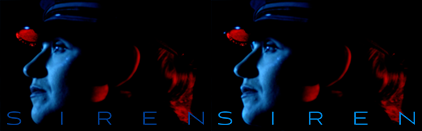
He has recently completed a short thriller entitled SIREN (2020), which had a successful worldwide film festival run that won 16 awards including Best Short Horror Film (Peephole FilmFest), Best Thriller Short (Vancouver Independent Film Festival), Best Experimental Film (South African Independent Film Festival), Best Cinematography (Rio Grind Film Festival), Best Sound Design (Mad Monster Party Film Festival) and the Best Acting Award (Montreal Requiem Fear Fest).
SIREN has also been screened in over 85 film festivals including the Hard:Line International Film Festival, which prizes “unusual storytelling methods (and) an exotic visual language... that could be important in the future of the genre.”
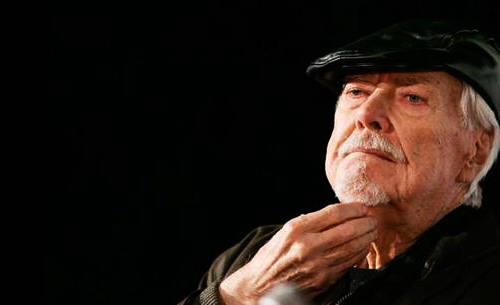
On November 2006, the world of cinema lost a giant. Director Robert Altman (1925 – 2006) was a maverick in Hollywood, a daring artist whose films captured the messiness and wonderment of human nature. Like John Sayles, a hero to independent film, Altman’s portrayals of community were personable, vast, and generous. Altman could juggle multiple story lines populated with dozens of characters and still make each one distinct and memorable.
Altman was popular in the 1970s, churning out great movies like M*A*S*H* (1970 – Altman hated the toothless TV show), McCabe and Mrs. Miller (1971), Nashville (1975) and Three Women (1977). After the success of Jaws (1975) and Star Wars (1977), the powers in Hollywood deemed that audiences — desire for worldly-conscious character studies had staled after being dazzled by pyrotechnical melodramas. Respectively, those blockbusters were just as compelling in their function in terms of character development than what we mostly get today. Suddenly studio heads wanted to make The Most Profitable Blockbuster™ instead of The Great American Movie. The revered Golden Age of Cinema came to a close. Enter the 1980s, the “Greed Is Good” decade, and Altman the Artist became an outcast in an industry that once embraced him for nearly a decade. Altman described his situation as being a shoemaker in a company that wanted him to make gloves.
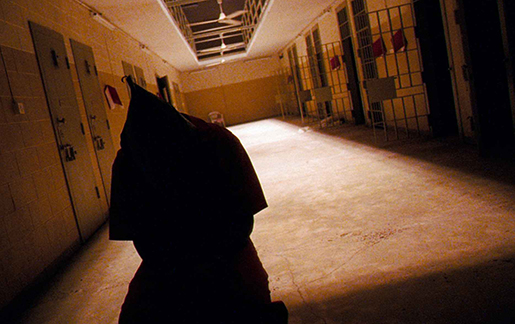
The price of freedom is tarnishing the moral upstanding of the United States of America. The Bush Administration may not have advertised that so broadly, but that’s what they were selling. Its president outright denied it: “We don’t torture.” They did and the American people bought it unaware what was happening behind the heavy curtain hiding the actions of Abu Ghraib and Guantanamo Bay. Had the American soldiers confined by their government to torture the prisoners for tainted information not taken a few hundred snapshots, we never would have known what was really going on. When the pictures were released around the world, America had to choke it down. Perhaps the photos were a blessing in disguise, everyone must become humbled before evil atrocities in their name.
Standard Operating Procedure follows the best examples of documented journalism from last year from Charles Ferguson’s No End In Sight to Tony Kaye’s Lake of Fire. The film has also won the Golden Bear at the Berlin Film Festival. Detective-Director Errol Morris (Gates of Heaven, 1978 and Mr. Death: The Rise and Fall of Fred A. Leutcher Jr., 1999) examines the shocking exposé of the Abu Ghraib torture-photography scandal with a dogged determination to simply analyze and discover the limited truth of the photos themselves. It also works as an apology from Morris, an American citizen. By taking the photographs, former MP Ken Davis figures that “(the soldiers) weren’t trying to hide anything.” G.I. Javal Davis reasons that “if you consider yourself dead, you can do all the shit you have to.” Upon the release of the photos to the American public, the government, its military and the people felt worse about this exposure than the actual crimes themselves. The soldiers were to blame while their superiors back home strolled back into the shadows.
Watching (May You Be In Heaven Half an Hour) Before the Devil Knows You’re Dead again, I was reminded what an inciting filmmaker legend Sidney Lumet is. His directorial resume strikes me with awe: 12 Angry Men (1957), Dog Day Afternoon (1975), Network (1976), Q&A (1990). In 2005, the Academy Awards honored Lumet with a Lifetime Achievement Award after being nominated for five awards in the past. Three years later at the age of 83, Lumet just makes another masterpiece as if it were easy.
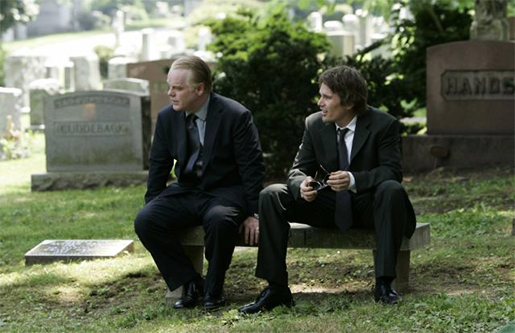
Now I have to tread carefully here because there are many revelations you should discover for yourselves. The film stars Philip Seymore Hoffman (Happiness, 1998) as Andy, a dominating businessman over Hank, his feckless brother played by Ethan Hawke (Before Sunset, 2004). They both need money desperately. Andy is caught in a vicious grip of drug use to cope with his rocky marriage and the money he is embezzling from his company to feed his habit. Hank, a pretty boy gone to seed, is way behind on alimony payment and is paralyzed by fear that his little girl will despise him as much as his ex. Marisa Tomei (Slums of Beverly Hills, 1998) plays Andy’s wife Gina who displays her body vindictively and suffers from personal demons.
In his office, Andy just about towers over Hank as he proposes a way to get some easy money by robbing a jewelry store, “a mom and pop operation”, one Sunday morning. In one of many chilling moments, Hank is hunch-shouldered and all twitches as he points out, “Andy — that’s mom and dad’s store”. Andy smiles, “it’s perfect.” They know the combinations to the safe. The woman opening the store is practically blind. Get in and out. Their parents are insured. No one gets hurt. It’s perfect!
by Christopher Beaubien • May 06, 2008 • 3 Comments
Some movies have one great scene lost in a bunch of not so great ones. Then there are some movies where it is a challenge to pick one over the others. Matinee falls in the latter category. It was directed by Joe Dante (Yes! I made three references to Gremlins all in one week!) who specializes in unveiling very dark things under the guise of campy B-movies. This is perhaps the most idealistic autobiography that Dante has ever realized.
Set in Small Town America – 1962, the film affectionately follows Lawrence Woolsey played by the versatile John Goodman as a schlock independent filmmaker who showcases gimmicky monster movies with great bravado. He is a low-rent version of William Castle, the mastermind behind Vincent Price vehicles like House on Haunted Hill (1959) and The Tingler (1959), a movie that shocked theater patrons with electric buzzers in their seats courtesy of Castle.
Woolsey’s next science fiction film MANT!, a loving homage by Dante to Kurt Neumann’s The Fly(1958), uses the Tingler Effect and other tricks to offer his audience a unique experience. Releasing an exploitation film about atomic radiation mutations when Americans feared the dropping of the bomb at the peak of the Cuban Missile Crisis is to Wollsey’s mind (“What better time to release a horror movie!”) Wollsey is not a cynical man; he genuinely loves making movies and entertaining people, within the confines of his capacity as a showman (the term ‘hack’ should be reserved for Michael Bay).
The Trailer for “MANT!”
Profiled like Alfred Hitchcock, the cigar-chomping Woolsey presents his preview for his cheerful creature feature titled Mant with the same dry humor and zest that The Master of Suspense did with his trailers. The way Woolsey presents the magazines that prove his cheap horror film is based on scientific fact is priceless. Watching this scene, compared to the bottom-line advertising tactics of films over the past few decades, one realizes filmmakers like Woolsey, whose gusto approach to making movies fun, are a dying breed. The only recent example I can think of is Rodriguez and Tarantino’s Grindhouse (2007). Dante never condescends but celebrates Woolsey the same way Tim Burton did for Ed Wood (1994) — Ed D. Wood Jr., director of Plan 9 from Outer Space (1959) and Necromania: A Tale of Weird Love (1971), was recognized as the “worst filmmaker of all time!”, which does deserve some reverence.
“You see, people come into your cave with a two hundred year old carpet.”
When I wrote that some films with great scenes are hard to choose from, case in point, here’s another one. Woolsey is accompanied by Gene, a young man not a mile away from myself, and learns some of the showman’s philosophy of movie-making. I still remember by heart the story told by Woolsey about the caveman who paints a Woolly Mammoth on his wall and figures: “Wait a minute! People are coming to see this thing! Let’s make it good!” A prime motive for how going for the jugular is more effective than subtlety (sometimes). The scene continues as Woolsey projects the point of view of any enthusiastic filmgoer’s journey through the matinee lobby and into the movie theater. Sometimes when I open the doors of a movie house with great anticipation I am inclined to call out, “Here I am! What have you got for me!”
For me, Woolsey represents a life path that is in considerable reach: an enthusiastic moviemaker touring far and wide in the pursuit of entertaining people. Another bonus is being accompanied by a sexy dry-wit like the one Woolsey takes along for the ride played by Cathy Moriarty (Raging Bull, the REAL Best Picture Winner of 1980). Other idealistic life paths include being a productive yet reclusive painter living in a New York apartment I could barely afford, or becoming a womanizing journalist who drinks too many highballs. This charming comedy about young love and B-Movies is highly recommended. Though I have been deprived of the experience for now, I believe, like Lawrence of Arabia and 2001: A Space Odyssey, the classic Matinee would benefit viewing on the big screen. Or, at the very least, a deluxe Criterion release.
Wow! I saw this trailer before Jon Favreau’s Iron Man this weekend and I felt an exhilaration that removed me from all planes of reality and into a dimension that can only be described as heaven. I hope that Christopher Nolan not only has made The Dark Knight the best Batman movie ever (even better than Bruce W. Timm’s Mask of the Phantasm, 1993), but the best film of the year. I want this film to be so compelling that no drama or foreign film will compete for me. I can only dream.
Everyone here looks in top form: Christian Bale (American Psycho, 2000), Michael Caine (The Quiet American, 2002), Maggie Gyllenhaal (SherryBaby, 2006) – Thank Nolan they replaced Holmes!, Gary Oldman (Nil by Mouth, 1998), dual performing Aaron Eckhart (In the Company of Men, 1998) and the brilliant Heath Ledger (Monster’s Ball, 2001).
Quick Tidbit: When the Joker whips open his blade as he walks down the urban street with his back to us, you can spot a Starbucks shop on the right part of the frame. I know, I have to go on a trailer diet.
Skewer Your Funny Bone: Recommended for Strong Stomachs
The short film Thanksgiving, posing as a faux trailer, was one of the highlights of Grindhouse, the Robert Rodriguez and Quentin Tarantino collaboration. Those two-and-a-half minutes (a pound?) are the best of Eli Roth’s resume. It is both a loving homage to John Carpenter’s definitive film Halloween (1978) and an inspired parody of those awful 80s slasher-rip-off-flicks (and bad taste, in general) that is far elevated from Roth’s turgid Hostel films. A.O. Scott of The New York Times wrote, “In any case be sure not to miss the trailer for Thanksgiving — not for the squeamish or the humor impaired, and not that you’d necessarily want to see the movie, if it existed.”
I remember the first time seeing it in theaters, the last act of abomination by the Evil Pilgrim on the roasted turkey had me laughing so hard throughout the main title sequence of Quentin Tarantino’s Death Proof, the best of both feature films. In the Kurt Volk designed collectible hardcover book Grindhouse, which chronicles behind its scenes, its director Eli Roth wrote a fascinating article about making Thanksgiving in Prague after dressing it up as Small Town, America. The read is explores technical as well as the drama creating these sick scenes (God love ’em!) to round out Roth’s gut-busting observations. It’s a mixed blessing Thanksgiving won’t be getting the Grindhouse feature treatment, we already have the best parts. Why let a lame narrative ruin that?
My only grip about this really guilty pleasure is this: What is the deal with not listing John Harrison as the composer of Thanksgiving in the end credits of the cheerfully sleazy three-hour double-feature? The majority of the music is lifted right off the soundtrack of George A. Romero’s immortal five-part Creepshow (1982), which was based on a Tales From the Crypt-like graphic novel written by Stephen King as the film’s screenplay.
In Thanksgiving, you’ll hear excerpts from Father’s Day, a Creepshow episode where Aunt Bedelia (Viveca Lindfors, A Wedding, 1978) is strangled to death by her cake-obsessed zombie-dad (John Amplas, Martin, 1977), which stands in as the Evil Pilgrim’s murderous theme song. Then the trampoline scene (Holy-NC-17-MPAA!) is accompanied by the music used for Something to Tide You Over when a jealous husband (Leslie Neilsen, The Naked Gun Series) watches, from the comfort of his living room, his wife and her lover drowning (Eat you heart out Peter Greenaway). Lastly, the sickly build-up to the near-thirty-year-old-depicting-a-teen (Eli Roth) head scene is from the They’re Creeping Up On You segment staring E.G. Marshall (Double Indemnity, 1944) as a corrupt, cockroach-phobic CEO. All are compositions by John Harrison.
The only original pieces of music by Nathan Barr, who was credited, are what follow: First, that menacing music at the beginning of trailer — following the knife-wielding maniac Halloween-style behind the buck-toothed screaming Grandma. And last, that perfectly drippy, romantic, synthesized 80s-like score playing over “Cool it, Judy! You’re safe. Bobby’s here…”
It seems strange, but this is the way credits work most of the time where original music versus licensed music is concerned. It’s not a matter of giving credit to the composer with the most music in the trailer, but rather giving credit for the most-recent music written specifically for that fake trailer.












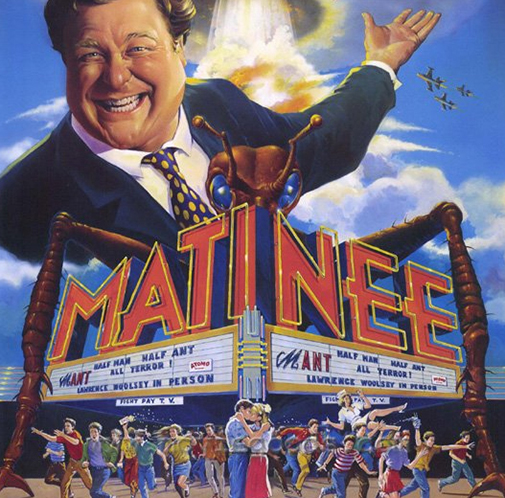
 Woolsey’s next science fiction film MANT!, a loving homage by Dante to Kurt Neumann’s The Fly (1958), uses the Tingler Effect and other tricks to offer his audience a unique experience. Releasing an exploitation film about atomic radiation mutations when Americans feared the dropping of the bomb at the peak of the Cuban Missile Crisis is to Wollsey’s mind (“What better time to release a horror movie!”) Wollsey is not a cynical man; he genuinely loves making movies and entertaining people, within the confines of his capacity as a showman (the term ‘hack’ should be reserved for Michael Bay).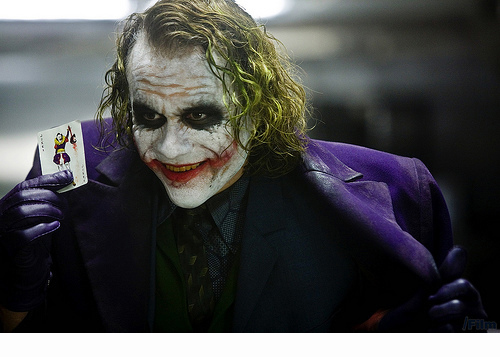
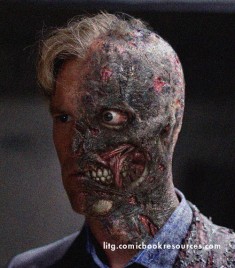 Everyone here looks in top form: Christian Bale (American Psycho, 2000), Michael Caine (The Quiet American, 2002), Maggie Gyllenhaal (SherryBaby, 2006) – Thank Nolan they replaced Holmes!, Gary Oldman (Nil by Mouth, 1998), dual performing Aaron Eckhart (In the Company of Men, 1998) and the brilliant Heath Ledger (Monster’s Ball, 2001).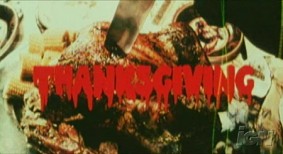
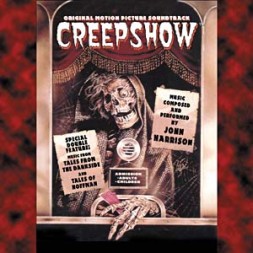 In Thanksgiving, you’ll hear excerpts from Father’s Day, a Creepshow episode where Aunt Bedelia (Viveca Lindfors, A Wedding, 1978) is strangled to death by her cake-obsessed zombie-dad (John Amplas, Martin, 1977), which stands in as the Evil Pilgrim’s murderous theme song. Then the trampoline scene (Holy-NC-17-MPAA!) is accompanied by the music used for Something to Tide You Over when a jealous husband (Leslie Neilsen, The Naked Gun Series) watches, from the comfort of his living room, his wife and her lover drowning (Eat you heart out Peter Greenaway). Lastly, the sickly build-up to the near-thirty-year-old-depicting-a-teen (Eli Roth) head scene is from the They’re Creeping Up On You segment staring E.G. Marshall (Double Indemnity, 1944) as a corrupt, cockroach-phobic CEO. All are compositions by John Harrison.