








Scene to be Seen: LOST IN TRANSLATION (2003)
In light of Roger Ebert’s latest inclusion of Sofia Coppola’s masterpiece Lost in Translation (2003) into his Great Movies archive, I have selected one of its best scenes with dialogue I hadn’t understood completely. Until now.
No, it is not the inaudible whisper before the movie’s end. I don’t ever want to know what Bob (Bill Murray) said to Charlotte (Scarlett Johansson) before they parted ways. That is between them and it is none of my business.
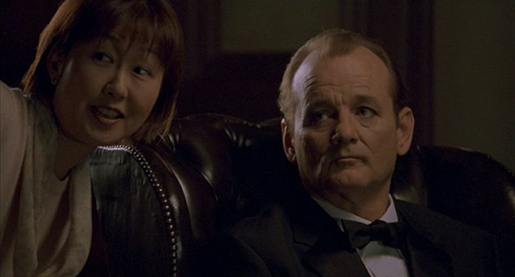
The scene in question is the awkward taping of the “Suntory Time” commercial. Like Harrison Ford and Brad Pitt before him, Bob Harris is one of many American actors being paid big bucks for promoting a product strictly for Japanese television. Not knowing a word beyond “saki,” Bob is at the mercy of a hyperactive director (Yutaka Tadokoro) and his kookily incompetent interpreter (Akiko Takeshita). The director passionately delivers lengthy instructions while the interpreter summarizes. This is serious business, but their struggle to communicate is as funny as a misunderstanding between Abbott and Costello. They’re all floundering, but there is no condescension. The human comedy works because the characters are sincere. We really feel for them and laughter alleviates the tension.

 Todd Solondz is one the most distinct filmmakers we have working today. Like watching one minute of a random movie by either Neil Labute or David Fincher without warning, you know it is by Solondz when you see one of his. My high anticipation for his new film Life During Wartime (2010), which premiered last year at TIFF (Toronto International Film Festive), is matched by seeing what its movie poster will look like — and for good reason. Over Solondz’s career from Welcome to the Dollhouse (1996) to Palindromes (2004), the posters of his films have been consistently inspired and in tune with each other. Their designs and illustrations(!) convey the sweet and sour qualities of his controversial themes, which engage and then subvert our expectations. Whether it is Solondz’s direct influence or just what each different advertising company happens to come up with when facing his material, the results in style are remarkably alike.